
10 Best Block Forming Machines for Global Buyers?
Selecting among the 10 Best Block Forming Machines for Global Buyers requires more than comparing production speed. It demands practical judgment, verified specifications, and awareness of local construction conditions. A modern Block Forming Machine must handle consistent aggregate grading, controlled moisture, stable vibration, and accurate mold alignment. Small differences matter. A poorly calibrated feeder can create chipped edges, uneven density, and expensive material waste.
Industry data explains why this equipment deserves careful evaluation. The 2024 UNEP Global Status Report for Buildings and Construction states that the sector consumes about 32% of global energy and produces approximately 34% of global carbon dioxide emissions. Efficient block production can support resource-conscious construction when machines reduce rejected units, unnecessary cement use, and downtime. Meanwhile, the Global Cement and Concrete Association emphasizes lower-carbon materials, resilient infrastructure, and improved manufacturing practices. These priorities affect machine selection, especially for buyers considering recycled aggregates, hollow blocks, paving units, or insulated masonry products.
This guide compares leading machines through production capacity, automation, mold flexibility, energy use, maintenance access, and after-sales support. It also considers operating realities: dusty workshops, unstable power supplies, limited technical staff, and long-distance spare-parts delivery. Manufacturer claims still require verification. Brochures may show ideal output, not daily factory performance. That is an important limitation. Buyers should request test results, sample blocks, warranty terms, and references from comparable plants. Standards such as ASTM and EN can help evaluate dimensional accuracy and compressive performance, but certification requirements vary by market. The best choice is rarely the fastest machine. It is the machine that delivers repeatable quality, manageable operating costs, and dependable support over many years.
What Are Block Forming Machines and How Do They Work?
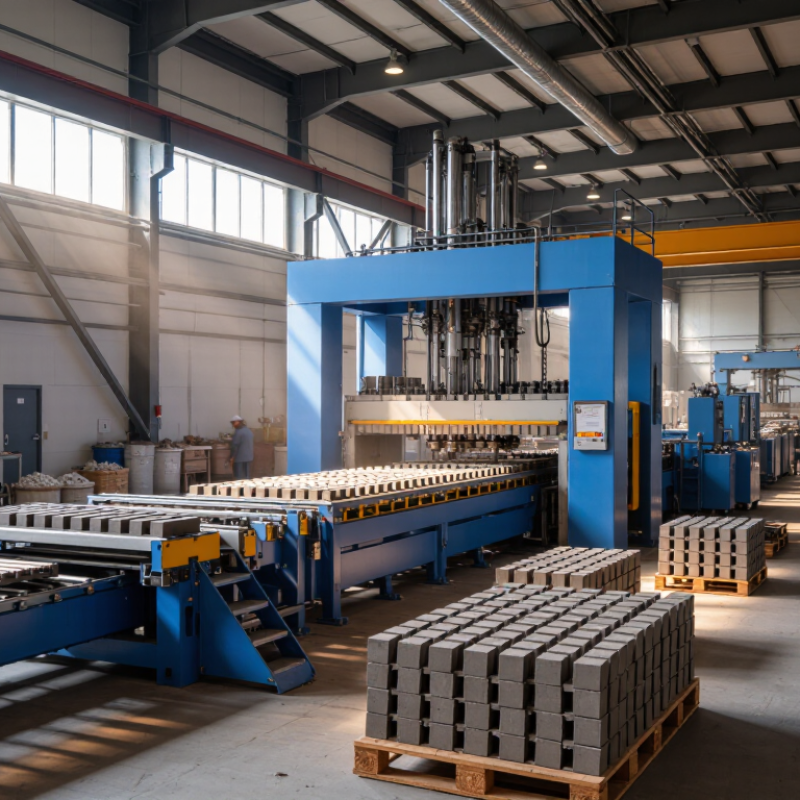
Block forming machines convert cement, sand, stone dust, and water into consistent masonry units. The process starts with controlled batching and mixing. The fresh material then enters a mold, where vibration and hydraulic pressure remove air pockets. A pallet receives each formed block before curing begins.
Modern machines may produce hollow blocks, solid units, paving blocks, or interlocking shapes by changing the mold and production settings. According to Grand View Research’s 2024 assessment, the global concrete block and brick manufacturing market is expected to grow steadily through 2030, with demand linked to urban construction and infrastructure development. However, output figures can mislead buyers. A machine rated for 10,000 blocks daily may achieve less with weak aggregates, unstable voltage, or slow manual handling.
A serious evaluation should examine mold accuracy, vibration frequency, hydraulic pressure, cycle time, and spare-part access. ASTM C90 and EN 771-3 provide useful reference points for concrete masonry unit performance, but the machine itself does not guarantee compliance. Mix design, curing temperature, moisture control, and operator skill remain decisive. The International Energy Agency reports that buildings and construction account for about 37% of global energy and process-related emissions. Efficient batching and reduced material waste therefore matter beyond production speed.
Buyers should request test blocks using local materials. Small trials reveal more than polished specifications. Mistakes happen. A cheaper machine can become expensive when molds wear quickly or curing space is ignored.
Key Factors for Comparing Block Forming Machines Worldwide
Comparing the 10 best block forming machines requires more than checking hourly output. USGS Mineral Commodity Summaries 2024 estimated global cement production at about 4.1 billion metric tons in 2023. That scale makes material efficiency important. Compare the machine’s cement consumption per block, mold accuracy, vibration control, and rejected-unit rate. A higher output number can mislead. Ask for test records using your local aggregate and cement mix.
Power demand also deserves close attention. The International Energy Agency reports that cement production creates roughly 7% of global CO2 emissions. Machines with efficient hydraulic systems, adjustable vibration, and shorter curing cycles may reduce operating costs. Review automatic controls, mold-change time, service access, and spare-part availability. EN 771-3 and ASTM C90 can guide product quality checks, while ISO 9001 certification may indicate disciplined production processes. It does not guarantee machine performance. Independent factory testing remains essential.
Tips: Request a 24-hour production trial, not a sales estimate. Calculate total cost per saleable block, including labor, electricity, maintenance, molds, and downtime. Check whether local technicians understand the control system. A compact machine may fit a small site better, although its future capacity could become limiting. No comparison is perfect. Weather, aggregate moisture, operator training, and curing space can change results significantly. Ask suppliers to document assumptions clearly, then challenge the weakest figure before signing.
Ten Leading Block Forming Machines for Global Buyers
Global buyers need more than a large production number. A reliable block forming machine must match local aggregates, power supply, labor skills, and building standards. Recent industry assessments place concrete masonry among the fastest-growing segments in affordable construction. Yet capacity figures can mislead. A machine rated at 20,000 blocks daily may produce less with poor moisture control or frequent mold changes.
The International Energy Agency reports that cement production creates about 7% of global energy-related carbon dioxide emissions. Therefore, efficient block production deserves serious attention. Buyers should compare motor efficiency, vibration control, curing requirements, and material waste. A practical line may use recycled aggregates, but testing remains essential. Small changes in water content can alter block strength and surface quality.
The UNEP 2023 Global Status Report states that buildings and construction consumed approximately 34% of global energy in 2022. This supports demand for durable, resource-efficient masonry products. For global purchasing, ten leading machine categories include manual, semi-automatic, fully automatic, mobile, hydraulic, vibration-based, multi-layer, hollow-block, paving-block, and interlocking-block systems.
I would not select equipment from output claims alone. Check sample blocks by compressive strength, dimensional tolerance, cycle stability, and noise levels. Ask for operating records, spare-parts availability, and technician training. These details feel ordinary. They often decide whether production runs smoothly.
How to Match Machine Types With Production Requirements
10 Best Block Forming Machines for Global Buyers?
How to Match Machine Types With Production Requirements
Choosing among the ten best block forming machines starts with the product, not the machine price. Define block dimensions, daily output, material mix, and available floor space. A small workshop may need a compact manual or semi-automatic machine. A large plant usually benefits from a fully automatic hydraulic system with pallet handling. Match the machine cycle to realistic production targets, not optimistic catalog figures.
Vibration strength and pressing force affect density, edge quality, and curing performance. For hollow blocks, confirm the machine supports the required core shape and wall thickness. For paving blocks, inspect mold changeover time and surface consistency. Moisture control matters too. A mix that feels slightly too wet can create chipped corners and weak surfaces. Test local sand, cement, and aggregates before signing a purchase agreement.
Consider maintenance access, operator training, spare-part availability, and electrical compatibility in the destination country. Machines with simple hydraulic circuits can be easier to repair in remote areas. Automated models reduce labor, but sensors and controls require skilled support. A factory should measure actual cycle times during a trial run. The fastest machine is not always the best choice. An overlooked mold change can erase its advantage. Buyers may also overestimate daily output by ignoring curing, pallet movement, and cleaning time. That mistake is common. The final selection should reflect measured production conditions, safety requirements, and the team’s practical ability to operate the equipment consistently.
10 Best Block Forming Machines for Global Buyers? - How to Match Machine Types With Production Requirements
| Rank | Machine Type | Typical Production Output | Best-Fit Products | Automation Level | Typical Power Range | Typical Mold Change Time | Space Requirement | Recommended Buyer Profile | Main Selection Advantage |
|---|---|---|---|---|---|---|---|---|---|
| 1 | Automatic Pallet-Circulation Block Machine | 800–2,000 standard blocks/hour | Hollow blocks, solid blocks, partition blocks, pavers | High; automatic feeding, forming, pallet transfer and stacking options | Approximately 35–90 kW, depending on line configuration | 30–90 minutes | Approximately 800–2,000 m² for a complete line and curing area | Large construction-material plants and high-volume exporters | High throughput, consistent dimensions and reduced labor per unit |
| 2 | High-Speed Stationary Vibropress | 600–1,200 standard blocks/hour | Hollow blocks, solid blocks, interlocking blocks and pavers | Medium-high to high | Approximately 25–75 kW | 30–75 minutes | Approximately 500–1,200 m², excluding large outdoor curing yards | Medium and large producers seeking flexible product changeovers | Good balance between productivity, product variety and investment level |
| 3 | Automatic Stationary Hollow Block Machine | 300–800 standard blocks/hour | Hollow blocks, concrete masonry units and partition blocks | Medium-high; automatic material feeding and pallet handling may be included | Approximately 20–55 kW | 45–90 minutes | Approximately 350–900 m², depending on curing and storage layout | Regional manufacturers with stable demand for standard blocks | Reliable daily production with moderate operating complexity |
| 4 | Concrete Paver and Block Combination Machine | 500–1,200 pieces/hour | Interlocking pavers, paving slabs, curbstones and solid blocks | Medium-high | Approximately 25–70 kW | 30–90 minutes | Approximately 400–1,000 m², including product handling space | Producers serving landscaping, roadwork and municipal projects | One machine platform can serve several high-value product categories |
| 5 | Semi-Automatic Hydraulic Block Machine | 100–300 standard blocks/hour | Hollow blocks, solid blocks and small-format pavers | Medium; manual pallet transfer and some manual handling are common | Approximately 10–30 kW | 60–120 minutes | Approximately 150–500 m² | Small and medium enterprises entering commercial production | Lower capital cost with better consistency than fully manual equipment |
| 6 | Mobile Egg-Laying Block Machine | 60–180 standard blocks/hour, subject to site conditions | Hollow blocks, solid blocks and simple paving units | Low-medium; the machine forms blocks directly on the concrete floor | Approximately 8–25 kW | 60–150 minutes | Requires a level production floor rather than a large fixed line | Construction contractors and buyers with limited fixed-site infrastructure | Low civil-work requirements and reduced pallet-handling needs |
| 7 | Manual or Hand-Fed Hydraulic Block Press | 40–120 standard blocks/hour | Basic hollow blocks, solid blocks and small batches of custom units | Low; feeding, demolding and handling are mainly manual | Approximately 5–15 kW | 90–180 minutes | Approximately 80–250 m² | Start-ups, rural projects and markets with low initial demand | Simple operation, low entry cost and easy local maintenance |
| 8 | Curbstone and Large-Unit Concrete Forming Machine | 80–250 pieces/hour, depending on unit size | Curbstones, drainage channels, retaining units and large solid blocks | Medium to high | Approximately 15–45 kW | 45–120 minutes | Approximately 250–700 m² | Municipal infrastructure suppliers and precast concrete yards | Designed for larger or specialized units that standard block machines cannot handle efficiently |
| 9 | Lightweight Concrete Block Foaming Line | Approximately 10–30 m³/day | Lightweight insulating blocks, non-load-bearing panels and fill blocks | Medium; batching, foaming and casting can be partly automated | Approximately 15–50 kW | Usually 1–3 hours for mold or production-format changes | Approximately 250–800 m², including curing and cutting areas | Builders and manufacturers targeting insulation and lightweight construction | Lower unit weight and improved thermal performance compared with ordinary concrete blocks |
| 10 | Multi-Layer Concrete Block Machine | 250–700 standard blocks/hour | Hollow blocks, solid blocks, pavers and landscaping units | Medium-high; products are formed in several layers on production pallets | Approximately 20–60 kW | 45–90 minutes | Approximately 300–800 m² | Factories requiring compact equipment with multiple product options | Efficient use of floor space and suitability for frequent product changes |
Data basis: Output, power, footprint and changeover figures are typical industry ranges for new equipment. Actual performance depends on block dimensions, concrete mix, curing method, mold design, operator skill, local electrical standards and the degree of automation. Output should be verified using the buyer’s target product and production schedule before purchase.
Purchasing, Installation, and Support Considerations for International Buyers
10 Best Block Forming Machines for Global Buyers?
For international buyers, machine selection begins with local production conditions, not catalog rankings. Check block dimensions, aggregate moisture, daily output, and available power. A machine rated for 20,000 blocks daily may perform differently with local sand. Request test samples using your own materials. Measure density, edge sharpness, cycle time, and rejected blocks.
Installation deserves equal attention. Confirm container dimensions, foundation requirements, voltage, air pressure, and spare-part availability before payment. The International Energy Agency reports that cement production creates about 2.5 gigatonnes of carbon dioxide annually. Therefore, buyers should compare motor efficiency, hydraulic losses, curing energy, and material waste. Lower consumption can matter more than a slightly faster cycle. It is easy to overlook.
Support must be measurable. Ask for remote diagnostics, operator training, electrical drawings, maintenance schedules, and response times in writing. The World Bank’s Logistics Performance Index 2023 shows major differences in customs, infrastructure, and shipment reliability between markets. Local service planning is essential when a replacement sensor may spend weeks in transit. Keep critical seals, relays, molds, and sensors on site. That is practical insurance.
Independent inspection can verify steel thickness, weld quality, safety guards, and actual output before shipment. ISO 9001 certification may support process reliability, but it does not guarantee machine performance. I would not trust a polished brochure alone. A factory visit, documented trial, and clear acceptance test provide stronger evidence. The best machine is the one your team can operate consistently, repair safely, and adapt to local demand.
