
China Top Thread Rod Manufacturers How to Choose?
Choosing among China’s top Thread Rod manufacturers requires more than comparing prices or catalog photos. A dependable supplier should prove material grade, thread accuracy, coating quality, production capacity, and batch traceability. These details matter when rods are used in structural connections, equipment installation, concrete anchoring, or industrial maintenance.
Dr. John H. Bickford, a recognized authority on bolted-joint engineering, offers a useful principle: “The joint, not the fastener alone, determines performance.” This idea should guide every supplier review. Ask whether the manufacturer understands the complete application, not merely the rod’s diameter and length. A serious factory can explain tensile strength, proof load, thread tolerance, straightness, and corrosion resistance in clear terms.
Look closely at production evidence. Request mill certificates, inspection reports, coating specifications, and sample measurements. Check whether the factory uses calibrated gauges and maintains consistent thread engagement. ISO 898-1, ASTM A193, ASTM A307, and project-specific standards may apply, depending on the application. Do not accept vague claims such as “premium quality.” Real quality leaves records.
Factory visits can reveal practical weaknesses. Threads may look clean while packing remains careless. A polished website proves little. Supplier communication also matters. Can the team answer technical questions without avoiding details? Can it manage custom lengths, urgent replenishment, and stable packaging?
The selection process is rarely perfect. I have seen buyers focus too heavily on unit price and overlook coating failures. That mistake becomes expensive later. A better choice balances engineering support, inspection discipline, delivery reliability, and honest communication. The lowest quote may not be the lowest total cost. Supplier testing should remain independent whenever the application carries serious risk.
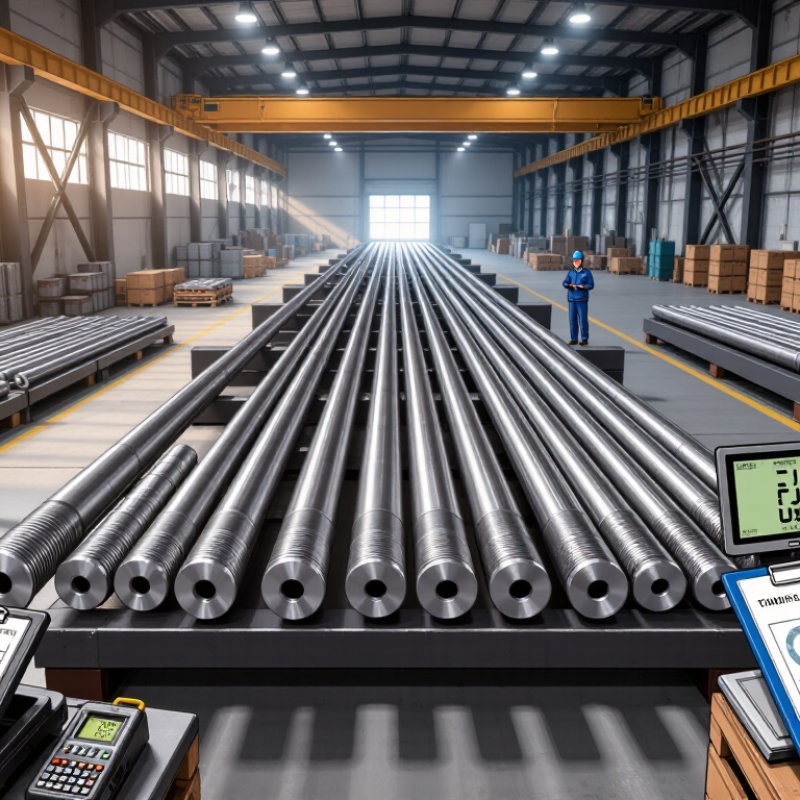
Define Thread Rod Types: ASTM A193, DIN 975, and ISO 898-1 Grades
Choosing China top thread rod manufacturers starts with identifying the correct standard, not comparing prices. ASTM A193 covers alloy and stainless steel bolting for high-temperature or high-pressure service. Grade B7 typically requires 125 ksi minimum tensile strength and 105 ksi minimum yield strength. It suits many industrial flanges and pressure systems, but not every outdoor application.
DIN 975 mainly defines continuous threaded rods, dimensions, and thread forms. Material and strength must be confirmed separately. ISO 898-1 classifies mechanical properties for carbon and alloy steel fasteners. Class 8.8 requires 800 MPa minimum tensile strength, while class 10.9 requires 1,000 MPa. These numbers matter when a rod carries structural loads. They do not replace corrosion testing.
Specification comes first.
A reliable manufacturer should provide heat numbers, mill certificates, hardness results, and calibrated thread-gauge records. Ask whether samples were tested under the exact grade requested. An inspection report should identify chemical composition, tensile strength, yield strength, elongation, and surface treatment. ISO 898-1 also warns that mechanical performance depends on diameter and testing conditions. That detail is easy to miss.
In practical sourcing, compare thread pitch with the mating nut, not only rod diameter. Check straightness under a simple rolling inspection. Verify coating thickness at several points, because one reading can mislead. Independent inspection is useful for large orders. I have seen buyers accept “high strength” wording without a grade certificate. That approach saves minutes, then creates expensive uncertainty.
China Top Thread Rod Manufacturers How to Choose? - Define Thread Rod Types: ASTM A193, DIN 975, and ISO 898-1 Grades
| Standard / Type | Primary Material Scope | Common Grades or Designations | Key Mechanical or Service Characteristics | Typical Applications | What to Confirm with a Manufacturer |
|---|---|---|---|---|---|
| ASTM A193 High-temperature and pressure-service bolting | Alloy steel and stainless steel bolting materials intended for elevated-temperature or pressure-containing service. | B7, B7M, B16, L7, L7M, B8 Class 1, B8 Class 2, B8M Class 1, B8M Class 2 | Grade-dependent strength, temperature capability, corrosion resistance, heat treatment, and hardness requirements. B7 is commonly supplied in quenched-and-tempered alloy steel; B8 and B8M are stainless steel classes. | Flanges, valves, pressure vessels, piping systems, petrochemical equipment, and power-generation equipment. | Specified grade, supplementary requirements, heat-treatment records, chemical composition, tensile properties, hardness, thread dimensions, coating, and certificate traceability. |
| DIN 975 Metric threaded rod / studding | General-purpose threaded rods with metric threads; the standard is primarily associated with dimensions and thread form rather than a single universal material grade. | Common market specifications include steel grades such as 4.8 or 8.8 and stainless steel such as A2 or A4, when separately specified. | Performance depends on the separately declared material and property class. Available in full-thread configurations and various lengths; corrosion resistance depends on material or surface treatment. | General construction, equipment installation, pipe supports, cable trays, suspended systems, machinery assembly, and non-pressure structural fastening. | Nominal diameter, pitch, length tolerance, thread tolerance, material grade, property class, surface finish, straightness, packaging, and whether the product is supplied to DIN 975 dimensions or a current equivalent specification. |
| ISO 898-1 Metric carbon-steel and alloy-steel fastener property classes | Carbon steel and alloy steel fasteners with specified mechanical-property classes. It is commonly used to define performance classes for metric threaded products. | 4.6, 5.6, 8.8, 9.8, 10.9, and 12.9; the applicable class depends on product design, size range, and manufacturing process. | The first number multiplied by 100 indicates the nominal tensile strength in MPa; the product of the two numbers multiplied by 10 indicates the nominal yield-stress ratio. For example, class 8.8 corresponds to approximately 800 MPa nominal tensile strength and a 0.8 nominal yield ratio. | High-strength machinery, steel structures, automotive and industrial assemblies, equipment frames, and load-bearing metric fastening applications. | Property class, nominal diameter range, tensile and yield requirements, proof load, hardness, decarburization, thread gauge inspection, heat treatment, marking, and test reports. |
Thread Rod Selection Checklist
| Selection Factor | Recommended Evaluation Method | Why It Matters |
|---|---|---|
| Application temperature and pressure | Use ASTM A193 only when the specified grade and design code are suitable for the service conditions; obtain the applicable material and test documentation. | General-purpose threaded rod should not automatically be substituted for pressure-service bolting. |
| Required load capacity | Select the required ISO 898-1 property class or ASTM A193 grade based on the engineering calculation, preload, diameter, and temperature. | Nominal diameter alone does not define the load capacity of a threaded rod. |
| Corrosion environment | Specify stainless grade, plating or coating, environmental exposure, and compatibility with nuts and washers. | A coating or stainless grade must be selected for the actual atmosphere and galvanic-contact conditions. |
| Dimensional compatibility | Confirm metric diameter, pitch, thread tolerance, length, chamfer, straightness, and nut compatibility. | Correct thread engagement and fit are essential for safe assembly and reliable preload. |
| Manufacturer quality control | Review quality-system certification, batch traceability, inspection plans, material certificates, mechanical test reports, and sample approval procedures. | Documented controls help verify that every production batch matches the specified standard and grade. |