
Why Is My Well Water Rusty and Which Iron Water Filter Should I Choose?
Rust-colored water can leave orange streaks in a sink, stain laundry, and give drinking water a metallic taste. The cause is often iron, but the color alone cannot identify its source. Iron may occur naturally in groundwater, enter through corroding pipes, or result from iron bacteria. Each cause calls for a different response. The U.S. Environmental Protection Agency lists 0.3 milligrams per liter as the secondary standard for iron, based mainly on aesthetic effects such as staining and taste, not a federal health limit. That distinction matters.
A laboratory water test is a better starting point than buying a filter by appearance. Ask for measurements of iron and manganese, and consider testing for pH, hardness, and bacteria when symptoms or local conditions warrant it. The U.S. Geological Survey explains that groundwater can dissolve iron from rocks and soil; plumbing can also add metals to water. A red-orange sample may contain dissolved iron that turns visible after exposure to air, or particles already suspended in the water. Those are not the same treatment problem.
Choosing an iron water filter for well water depends on the iron’s form and concentration, the water’s chemistry, and household flow needs. Oxidation and filtration can work for some wells; other water may need different media or pretreatment. There is no universal cartridge. Even a clear sample can be misleading, and test results need interpretation. This guide explains common causes of rusty well water, which tests help, and how to compare filter types before investing.
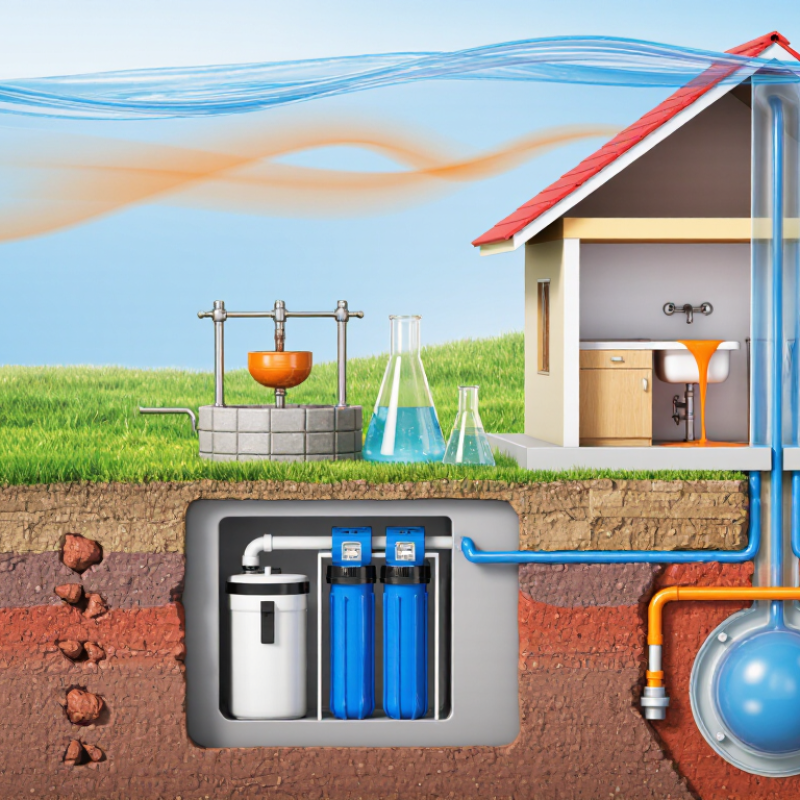
Identify Rusty-Water Symptoms and Iron’s 0.3 mg/L EPA Secondary Standard
Why Is My Well Water Rusty and Which Iron Water Filter Should I Choose?
Rust-colored water can leave orange streaks in a sink, stain laundry, or carry a metallic taste. These clues often point to iron, but color alone cannot identify its form or concentration. The U.S. Environmental Protection Agency sets a secondary, aesthetic standard of 0.3 milligrams per liter (mg/L) for iron. It is guidance for taste, color, and staining, not a health-based federal limit. Still, a rusty tap deserves investigation.
Iron may appear as dissolved ferrous iron, which can run clear and turn orange after exposure to air. Or it may arrive as visible particles that settle in a sample jar. The distinction matters. EPA’s secondary standards list iron at 0.3 mg/L and manganese at 0.05 mg/L; both can contribute to discoloration, so a laboratory test is more useful than guessing from a stain. Test for iron, manganese, pH, and hardness. A filter chosen before testing may miss the problem.
For dissolved iron, oxidation followed by filtration can be appropriate; particulate iron may call for sediment filtration. Water chemistry and iron concentration affect performance, so no single filter suits every well. Ask for test results and rated treatment conditions before choosing equipment. The 0.3 mg/L figure is a practical benchmark, not a diagnosis. I would not treat it as one. A rusty bucket is a clue, not proof.
Sources: U.S. EPA, National Secondary Drinking Water Regulations, 40 CFR Part 143; EPA, Secondary Drinking Water Standards: Guidance for Nuisance Chemicals.
Why Is My Well Water Rusty and Which Iron Water Filter Should I Choose? — Identify Rusty-Water Symptoms and Iron’s 0.3 mg/L EPA Secondary Standard
| Observed symptom | Possible iron form or cause | Useful confirmation | Typical treatment approach | Selection considerations |
|---|---|---|---|---|
| Clear water at the tap turns orange-brown after standing; reddish stains appear in sinks or laundry. | Dissolved ferrous iron may oxidize when exposed to air, forming visible ferric iron particles. | Test a fresh, unfiltered sample for total iron; compare it with a sample after exposure to air. A laboratory test can distinguish dissolved and particulate iron. | Oxidation followed by filtration, or a properly sized iron-removal filter selected for the measured concentration and water chemistry. | Confirm pH, iron concentration, flow rate, and whether manganese or hydrogen sulfide is also present. |
| Water is orange, red, or brown as soon as it comes from the tap; sediment may settle in a glass. | Oxidized ferric iron or iron-bearing sediment may be present in the water or plumbing. | Collect a sample before and after flushing the tap. Check total iron and suspended solids; inspect the well and plumbing if the change is sudden. | Sediment filtration may help with particles. Oxidation and filtration may be needed when dissolved iron is also present. | A sediment filter alone does not remove dissolved iron. Choose a filter based on particle size, loading, and required service flow. |
| Orange-brown or black slime appears in toilet tanks, drains, or plumbing fixtures. | Iron-related bacteria can contribute to slimy deposits; iron may also be present in the water. | Have the well water tested and ask a qualified professional to assess the well and plumbing. Slime alone does not identify the cause. | Address the well or plumbing condition first. Disinfection may be considered by a qualified water professional; filtration may be needed for iron removal afterward. | Do not assume a standard cartridge filter will control bacteria. Investigate recurring slime or sudden changes in water quality. |
| Metallic taste, orange staining, or reddish-brown laundry marks. | Iron is a likely contributor, though other water-quality or plumbing conditions can produce similar complaints. | Use a certified laboratory or local health department to test iron, manganese, pH, hardness, and other locally relevant parameters. | Choose treatment only after testing. Options can include oxidation-filtration systems, iron-specific media, or other treatment matched to the water. | Compare rated iron capacity, operating pH range, backwash needs, maintenance, and treatment flow. |
| Rusty water appears only at one faucet or after plumbing work. | Corrosion or accumulated deposits in a fixture, pressure tank, water heater, or household plumbing may be responsible. | Compare samples from several cold-water taps, including a point close to the pressure tank. Check whether hot water is affected separately. | Inspect and repair the affected fixture or plumbing component; a whole-house filter may not be necessary if the source is localized. | Determine whether the source is the well or household plumbing before purchasing treatment equipment. |
| Iron test result is above 0.3 mg/L, even if water looks clear. | Iron may be dissolved and not visibly apparent until it oxidizes or accumulates. | Confirm the result with a laboratory sample collected and preserved according to the laboratory’s instructions. | Match treatment to the iron form, concentration, pH, flow demand, and other measured contaminants. | EPA lists 0.3 mg/L as a non-enforceable secondary drinking-water standard based on aesthetic effects such as taste, color, and staining; it is not a federal health-based maximum contaminant level. |
| Water has black staining or dark particles as well as rusty staining. | Manganese may be present along with iron. | Test manganese separately; appearance alone cannot reliably determine its concentration. | Select a system specifically rated for the measured iron and manganese levels, with any required oxidation and pH conditions. | Verify that the treatment media and system capacity cover both contaminants and that maintenance instructions can be followed. |
Before choosing a filter: Test the well water for iron, manganese, pH, hardness, and other locally relevant contaminants. Iron treatment performance depends on water chemistry and system sizing. The EPA’s 0.3 mg/L iron value is a secondary, aesthetic guideline, not a federal health-based limit. For private wells, owners are responsible for testing; follow state or local guidance and use a qualified laboratory.
Related Posts
-
7 Tips for Choosing the Best Well Filtration System
-

How to Choose the Best Well Water Filtration System?
-
2026 Best Well Filtration System for Clean Safe Water
-
How to Choose Water Systems for Well Water in 2026?
-
How to Choose the Best Well Water Filter?
-
2026 Best Water Filtration Systems for Well Water?